telemetry.
Production intelligence, delivered where the work already happens. telemetry reads the documents your production generates, compares plan to actual every day, and surfaces the signals early enough to act on. No new software to learn. No workflow to change.
How it works.
telemetry is built around three movements. Ingest what already exists. Compare plan to actual every day. Deliver the finding to the people who can act on it.
Your production generates documents whether you use telemetry or not. Call sheets. DPRs. Cost reports. Hot costs. Schedules. Scripts. Time cards. Script supervisor notes. That corpus already contains the operational reality of the production. telemetry reads it, structures it, and runs the comparison you don't have time to run yourself.
The daily email that changes the timing of expert judgment.
Most production intelligence tools put the insight behind a login. You open the dashboard when you remember. You read yesterday's report the next morning. By the time you see the pattern, it has been compounding for another day.
Production Pulse inverts that. The finding comes to you, in the inbox you already check before set. It names what moved overnight. It flags the compounding patterns. It gives you the one or two decisions worth thinking about before the crew shows up.
Producers read the Pulse. Executives read the Pulse. Department heads read the Pulse. Each version is scoped to what that role needs. No one gets the firehose.
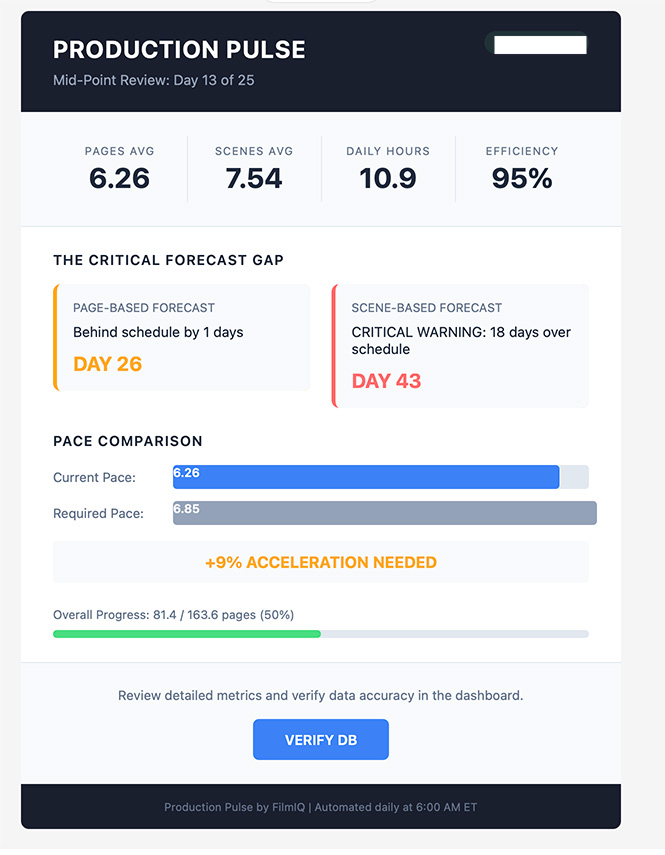
What the Pulse contains.
Pace. Page velocity, shooting progress, day-over-day change.
Drift. Cumulative scene deficit, overtime cadence, schedule variance.
Documents. What was ingested overnight, and what's still missing.
Flags. The compounding patterns telemetry thinks are worth your attention, with the reasoning behind each flag.
Open questions. Where the data is ambiguous and a human judgment is needed.
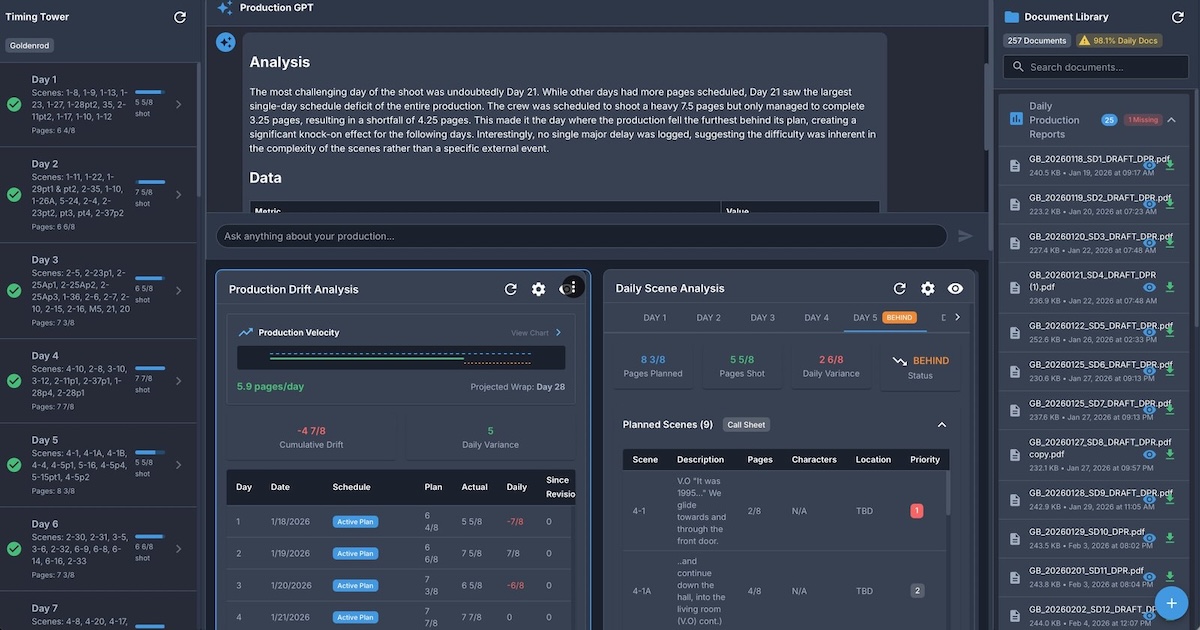
When you want the full picture, open the dashboard.
The Pulse is what you read every morning. The dashboard is where you go when a flag needs investigating, when a department head pushes back on a finding, or when an executive asks for the detail behind a summary number.
Timing Tower. Day-by-day pace across the production. Every day is a card. Every card tells you what was shot, what was planned, and how the deficit is moving.
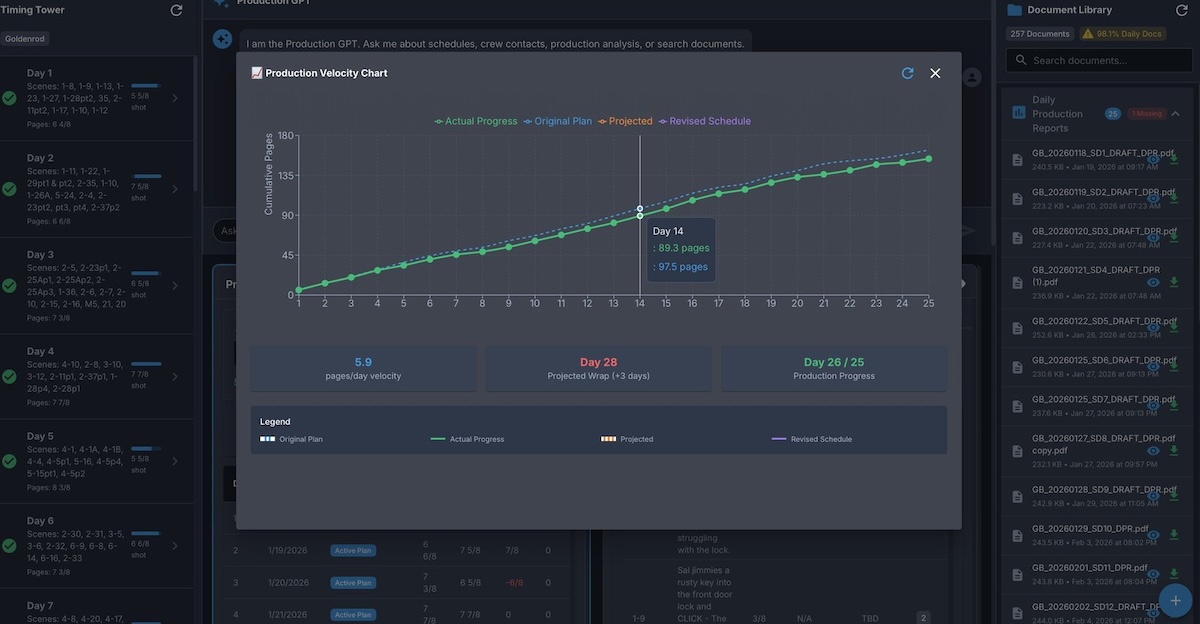
Production Velocity. Actuals against plan across the whole production. A single view of whether the production is tracking, pacing, or pulling apart.
Daily Scene Analysis. Scene-level detail for any day. What moved, what was added, what was dropped.
Document Library. Every file telemetry has ingested. Parsing status on each. A direct line to the source any flag is pulling from.
Production GPT. Ask telemetry a question in plain language. It answers from your documents, not from general knowledge.
Where telemetry is going.
telemetry's capability sits on a three-stage arc. We are building the second stage now. The third stage is on the roadmap.
Detect.
Read the documents. Structure them. Compare plan to actual across operations, creative vision, and contractual constraints. Surface the compounding patterns. This is what telemetry does today, and what early pilot work has demonstrated.
Query.
Ask telemetry direct questions in plain language. What's the current page drift? How complex is Day 6? Who is the First AD? Production GPT is the first version. Operational today, against a constrained question set, and expanding.
Scenario.
Model the second-order effects of a change before the change is made. A lead actor is unavailable. A location needs to move. telemetry maps the downstream impact across scenes, locations, departments, and schedule.
How telemetry is built.
Four architectural choices define the product. All four came out of what we learned from early pilot work.
Layered truth, not single source of truth.
Standard production software (legacy desktop tools and current AI-era platforms alike) frames its product around "single source of truth." That framing is structurally wrong for what telemetry does. The schedule, the DPR, the cost report, and the script disagree constantly, by design. They are different authorities recording the production at different time horizons. telemetry holds those layers separate, reads the gaps between them, and detects what moves through the gaps as the signal. Reconciling the gaps away is the step that destroys the signal.
Email-first ingestion.
telemetry ingests through email because that's how production documents already move. Every production already has a distribution list. We become one address on that list. No portal. No integration project. No ask of the production team beyond what they are already doing.
Expert-validated pattern library.
The drift signals telemetry flags are not induced from the data. They are defined by working producers and validated against operational history. The patterns encode what experienced practitioners already know, which is one of the few reliable ways to separate meaningful signal from noise in an environment where no two productions behave identically.
Reasoning at every layer.
Every flag telemetry raises is traceable. You see the signal. You see the reasoning behind the signal. You see the underlying documents the reasoning is drawn from. Three reasoning layers: signal, rationale, evidence.
What telemetry is not.
Being honest about the edges of what the product does is part of how it earns trust.
telemetry is not a cost-cutting tool. It does not recommend how to produce a scene more cheaply. It does not substitute for a UPM, a line producer, or a studio finance team. It is not a budgeting system, a scheduling system, or a replacement for Movie Magic, StudioBinder, Croogloo, Yamdu, or any of the tools your production already uses.
telemetry is also not a single source of truth platform. The standard "SSOT" framing assumes the production's documents reconcile into one canonical record. They don't. Schedule, DPR, cost report, and script are legitimately plural. The disagreements between them are how the production records itself across multiple authorities. telemetry holds the layers separate and reads the gaps between them as the signal.
telemetry is an intelligence layer that sits above your tools and reads the documents they produce. It operates upstream of cost decisions, not as a substitute for them. The question telemetry is built to answer is not "how can we spend less?" The question is "is what is being built still what was financed?"
How to bring telemetry onto a production.
The onboarding is short by design.
We set up a dedicated ingestion address and dashboard URL for your production.
You add the address to your existing distribution list.
telemetry begins ingesting documents the same day. Parsing and structuring happen overnight.
The first Production Pulse lands in your inbox the morning after.
From first conversation to first Pulse is typically under a week. Active productions, post-greenlight productions, and productions in late pre-production are all live candidates.
See telemetry against your own production.
The fastest way to understand what telemetry does is to see it running on a production you know. We set up a walkthrough using either an anonymized deployment or, with your team's permission, a short read against documents from a completed production.